

ESC or click to close
|
Press releases and reports
Attitude towards teaching Russian in Ukrainian-language schools
The press release was prepared by Anton Hrushetskyi, executive director of KIIS
From February 14 to March 4, 2025, the Kyiv International Institute of Sociology (KIIS) conducted its own all-Ukrainian public opinion survey "Omnibus", to which, on its own initiative, it added a question about the attitude towards studying the Russian language in schools. By the method of telephone interviews (computer-assistedtelephoneinterviews, CATI) based on a random sample of mobile phone numbers (with random generation of phone numbers and subsequent statistical weighting) in all regions of Ukraine (the territory controlled by the Government of Ukraine), 1,029 respondents were surveyed. The survey was conducted with adult (aged 18 and older) citizens of Ukraine who, at the time of the survey, lived in the territory of Ukraine controlled by the Government of Ukraine. The sample did not include residents of territories temporarily not controlled by the Ukrainian authorities (at the same time, some of the respondents are IDPs who moved from the occupied territories), and the survey was not conducted with citizens who left abroad after February 24, 2022. Formally, under normal circumstances, the statistical error of such a sample (with a probability of 0.95 and taking into account the design effect of 1.3) did not exceed 4.1% for indicators close to 50%, 3.5% for indicators close to 25%, 2.5% for indicators close to 10%, 1.8% for indicators close to 5%. Under the conditions of war, in addition to the specified formal error, a certain systematic deviation is added. Factors that may affect the quality of results in "wartime" conditions were previously cited by KIIS. In general, we believe that the obtained results are still highly representative and allow a fairly reliable analysis of the public moods of the population.
KIIS continues to monitor public moods related to the language situation and language policy in Ukraine. After the full-scale invasion of 2022, we observe the formation of a consensus view on these issues. In particular, 84% of Ukrainians in general and 81% of Russian-speaking Ukrainians in particular claim that there is no systematic oppression or restrictions on Russian-speaking citizens in Ukraine[1]. 81% believe that the Russian language should not be present in official communication throughout the territory or at least are against its use in their region[2]. And although some differences in the views of residents of different regions and residents who communicate in Ukrainian/Russian remain, the situation has significantly leveled out. Below we examine the dynamics of one of our monitoring questions, which serves as an important marker for understanding public moods regarding language policy – the attitude towards learning Russian in schools. But before moving on to this question itself, it is worth considering the respondents’ answers on what language they generally speak at home, and how the situation has changed since the full-scale invasion.
Language of communication at home
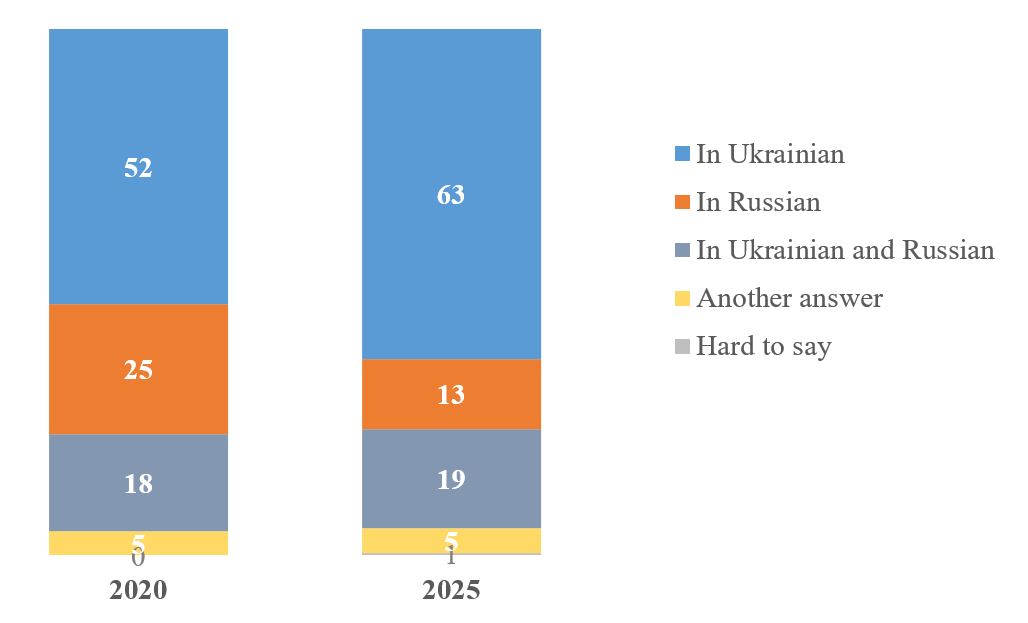
The majority of respondents – 63% – say they speak Ukrainian at home. 13% speak Russian, and another 19% say they speak Ukrainian and Russian equally. The graph also shows data for 2020. As can be seen, the share of those who communicate in Ukrainian has increased from 52% to 63%. At the same time, the number of those who communicate in Russian has decreased from 25% to 13%. The share of those who communicate in both languages has not changed – 18% in 2020 and 19% now.
Graph 1. What language do you usually speak at home?
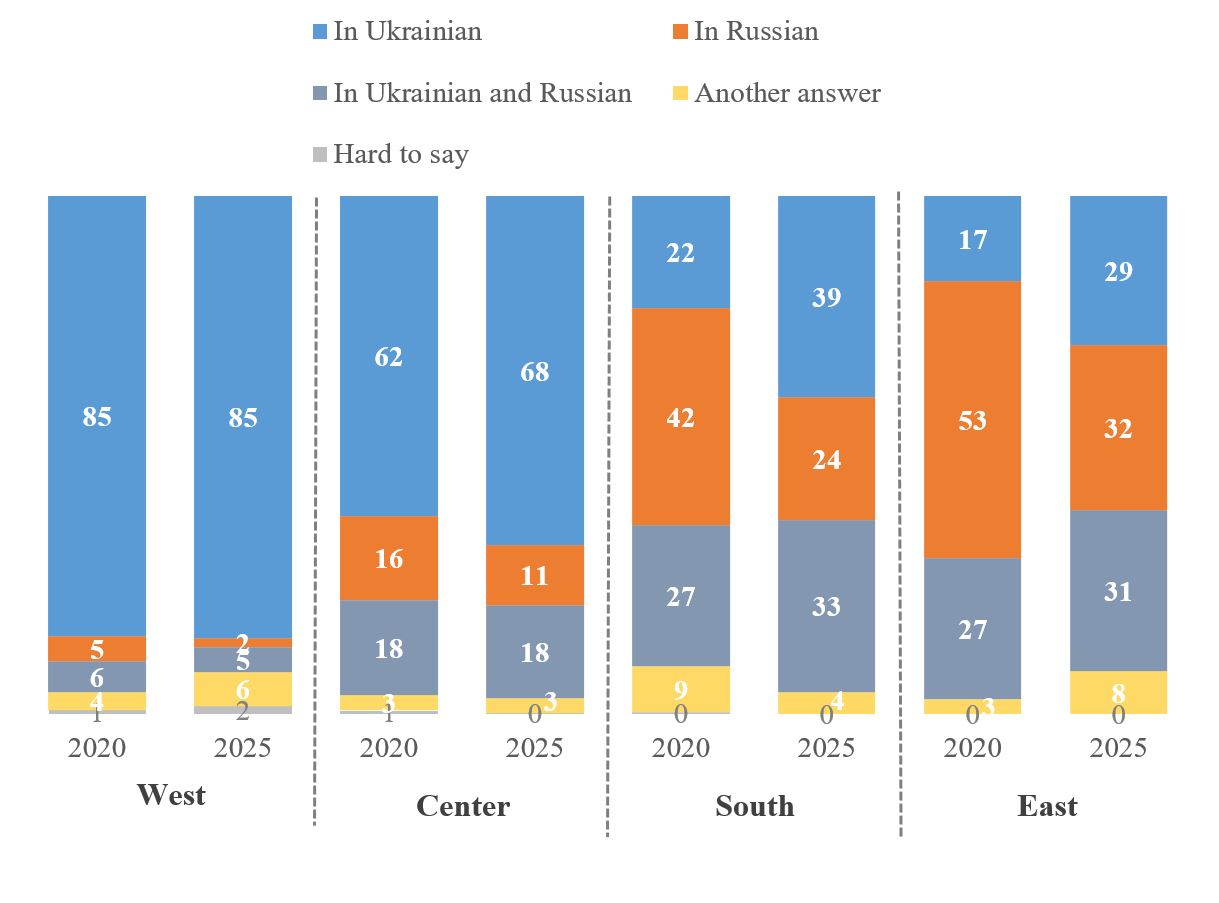
The graph below shows the dynamics in terms of regions[3]. Although regional differences are still noticeable, they have significantly diminished since the invasion due to the increased use of the Ukrainian language in the South and East. So, in the West there were almost no changes – as in 2020, so in 2025, 85% claim to communicate in Ukrainian. In the Center, there is some growth in the use of Ukrainian – from 62% to 68%. At the same time, there are fewer people who say they use Russian, from 16% to 11%. The share of those who speak both languages equally has not changed – 18%. In the South, the number of people who speak Ukrainian at home increased from 22% to 39%, in the East – from 17% to 29%. At the same time, the share of Russian speakers in these regions has decreased from 42% to 24% in the South and from 53% to 32% in the East. About a third of the population in these regions claim to speak Ukrainian and Russian equally (in 2020, it was about a quarter).
Graph 2. Language of communication at home in regional dimension
However, it should be taken into account that in the territories occupied after 2022, the use of the Russian language was widespread, so although the growth in the use of the Ukrainian language between 2020 and 2025 took place, it was most likely on a somewhat smaller scale than graphs 1-2 may show. At the same time, a 2023 KIIS survey for NDI showed that 89% of Ukrainians noted that after the invasion they began to use the Ukrainian language more[4] (in particular, among Russian-speaking respondents, more than 60% began to use Ukrainian more). The choice of language for the interview is also illustrative[5]: in the 2020 survey, 64% chose Ukrainian for the interview, 36% - Russian. And in the 2025 survey, 88% chose Ukrainian, 12% - Russian. Thus, it can be argued that after the full-scale invasion, a significant part of the population did switch to using the Ukrainian language. At the same time, the scale of the changes at first glance (and taking into account the correction in the territory where the survey was conducted) may not look as large as one might expect. However, it is important to focus on, first, a significant increase in the representation of the Ukrainian language in the communication of Ukrainians (as evidenced by the data of the KIIS survey for NDI). Secondly, while at the level of specific practices the changes may not seem so great, the most significant changes take place at the symbolic/value level, where the Ukrainian language has asserted its importance as one of the most important components of Ukrainian national identity. We see this, in particular, in the choice of language for interviews, in the perception of the official status of the Ukrainian/Russian language, and in the data discussed further in this press release (and in other data). Thirdly, despite all these changes, a significant part of Ukrainians continue to use (to a greater or lesser extent) the Russian language in their everyday lives (and as various KIIS data show, such Ukrainians also have completely pro-Ukrainian views – they strongly condemn Russia, support Euro-Atlantic integration, etc.). Now let’s move on to the subject of this press release – how Ukrainians feel about learning Russian in schools.
Should the Russian language be studied in Ukrainian-language schools
One of the questions that KIIS has been asking since the 1990s concerns the attitude towards learning Russian in Ukrainian-language schools. After the full-scale invasion, we asked this question in 2023[6] and recorded a significant increase in those who are against learning Russian at all. If in 2019 81% believed that Russian should be studied in schools (although the amount of study was debatable), then in 2023 their share decreased to 42%. At the same time, the share of those who are against learning Russian at all increased from 8% to 52%. As can be seen in the graph, In Ukraine, the share of those who believe that Russian should not be studied at all in Ukrainian-language schools continues to increase - in 2023 there were 52%, now - 58%. At the same time, the number of those who believe that Russian should be studied in schools has decreased from 42% to 38%. It should be noted that among these 38% who believe that Russian is worth studying, only 9% say that it should be studied at the level of Ukrainian or at least at a higher level than other foreign languages (for example, English). The remaining 29% believe that it should be studied at the level of other foreign languages or even at a lower level.
Graph 3. In your opinion, should the study of Russian in Ukrainian-language schools be given priority …
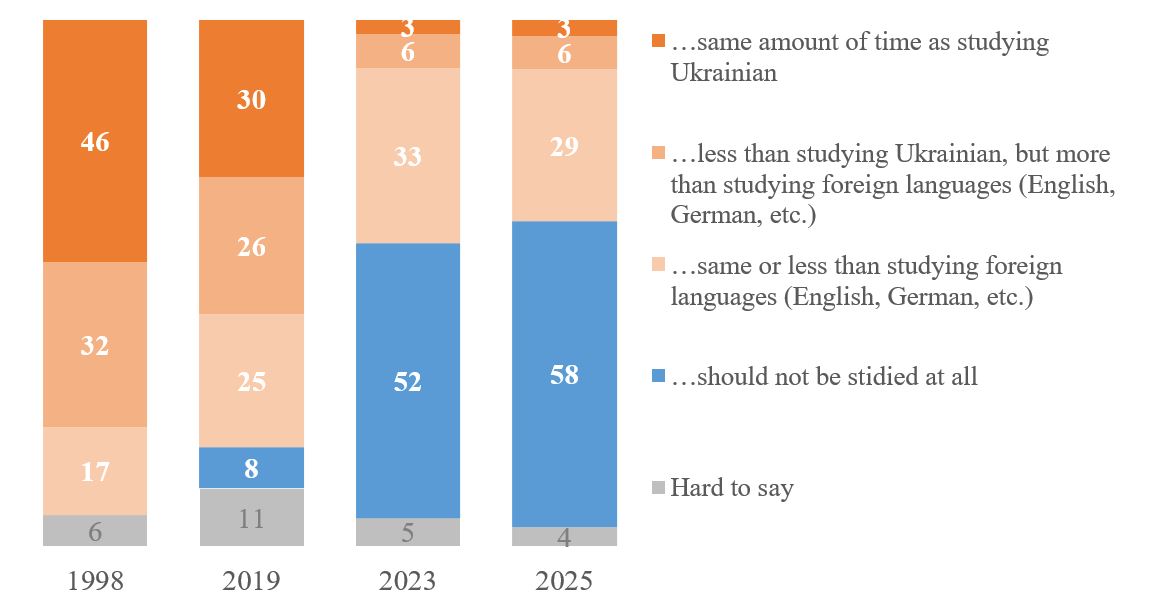
* The 1998 survey did not have the option “should not be studied at all”, but there was an option “other” (0.4%, added to “hard to say” in the graph). The 1998 survey also covered the entire Donbas and Crimea. However, taking this factor into account would not have significantly affected the meaningful results and understanding of key trends.
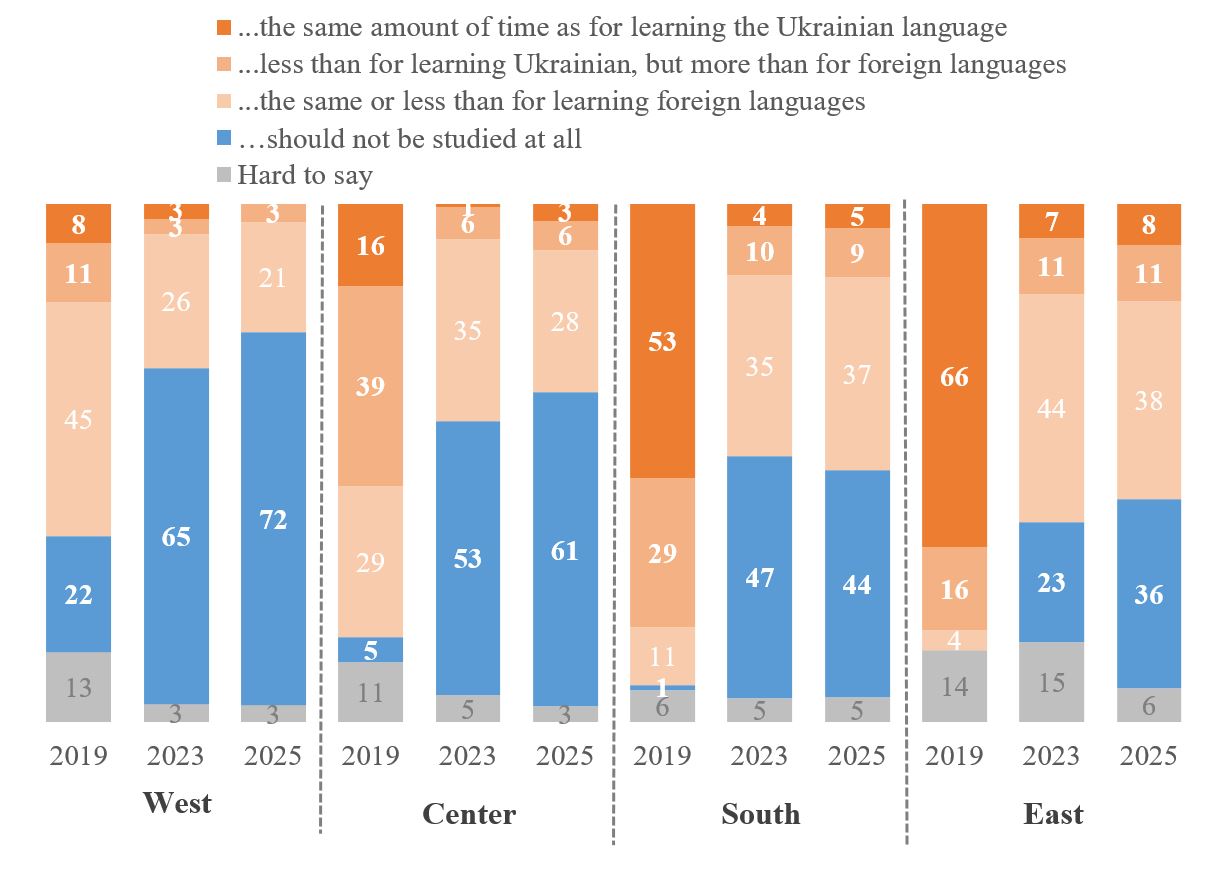
The graph below shows the data in regional terms. In all regions of Ukraine, compared to 2019, there have been significantly more people who oppose the study of the Russian language. Moreover, in the period between 2023 and 2025, we do not currently see, for example, a “rollback”. On the contrary, in some regions, the idea that the study of the Russian language in schools is inappropriate continues to spread. At the same time, the share of those who would still like to preserve the study of the Russian language in schools is increasing from West to East. Thus, in Western Ukraine, 25% believe that Russian should be studied (down from 32% in 2023), while 72% are against it (up from 65% in 2023). In the Center, 36% already believe that Russian should be studied in schools (42% in 2023), while 61% are against it (53% in 2023). In the South, the situation has not changed since 2023 and an almost even split remains – 51% believe that Russian should be studied (mostly at the level of other foreign languages or lower), and 44% believe that it should not be studied at all. Recall that in 2019, only 1% in the South believed that it should not be studied. In Eastern Ukraine, compared to 2023, there are more people who are against learning Russian – from 23% to 36%. At the same time, 57% believe that it is worth learning (in 2023 – 61%).
Graph 4. Studying Russian in Ukrainian-language schools in a regional dimension
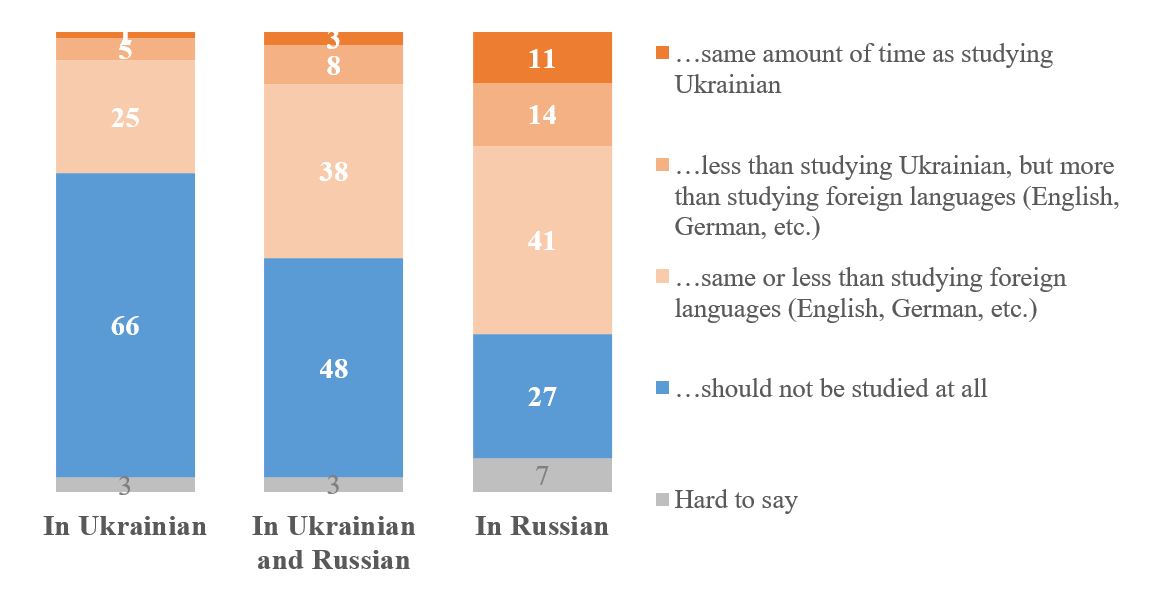
Among those who speak Ukrainian at home, 66% are against studying Russian in schools. At the same time, 31% allow its study. Among those who speak Ukrainian and Russian equally, opinions are evenly divided - 48% are against studying Russian in schools, and 49% believe that it is possible to study. Among respondents who speak Russian at home, 66% believe that Russian should be studied in schools. At the same time, every fourth Russian-speaking respondent is against studying Russian in schools. At the same time, in all cases, among those who generally allow the study of Russian in schools, it is mainly about studying it at the same level as other foreign languages, or even at a lower level.
Graph 5. Learning Russian in Ukrainian-language schools in terms of the language of communication at home
Why do people think that Russian should be studied in schools
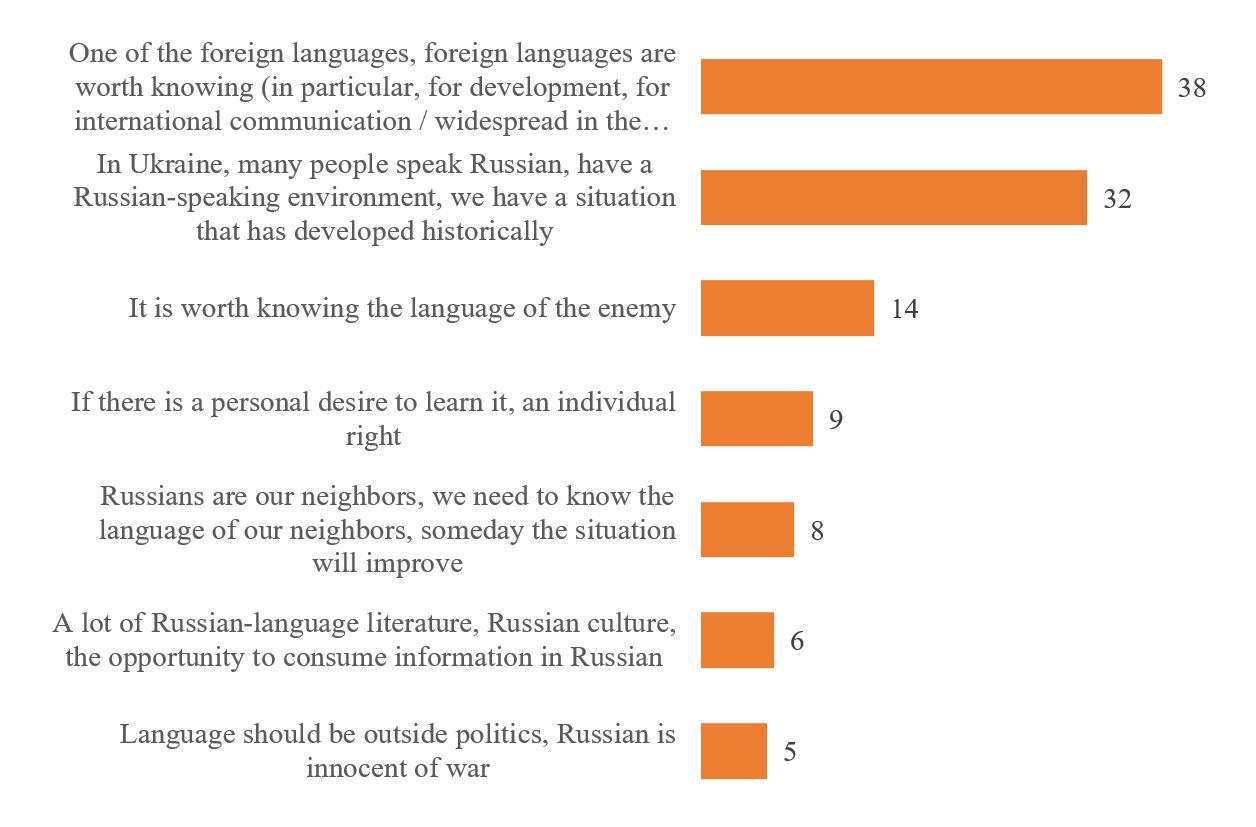
There may be various reasons why respondents believe that Russian should be studied in schools. We asked respondents who believe that Russian should be studied in an open-ended manner what exactly they explained their opinion. The top answers are presented in Figure 5 below (all answers are in the Annex). The most common explanations are that Russian is one of the foreign languages, and foreign languages in general are worth knowing (for development, for international communication, etc.) (38% of such respondents give this explanation), as well as that this language is widespread in Ukraine / there are historical circumstances (32%). The top 3 answers also include the idea that it is worth knowing the enemy's language (14%).
Graph 6. And why exactly do you think that Russian should be studied in Ukrainian-language schools? Open question, % among those who believe that Russian is worth learning, top answers
A. Hrushetskyi, comments on the survey results:
After intensive discussions in the 1990s, 2000s, and 2010s, we see a movement toward consensus at the national and interregional levels. The language issue has lost its former sharpness, but it still retains the potential in a certain context (especially electoral) to be actualized and transformed into a “fault line.”. On the one hand, the majority consider Russian-speaking Ukrainians to be part of the Ukrainian nation[7]. Also, 83% of the population is ready to allow Russian-speaking residents of Ukraine into their environment. Only 17% have a xenophobic attitude towards them, and the social distance index is average (3.7 on a scale of 1-7, where 1 corresponds to the closest attitude)[8]. On the other hand, according to the same data, we see that Russian-speaking citizens are expected to make somewhat more “efforts” (or “evidence”) to prove their belonging to the Ukrainian nation. And according to the social distance index, the indicator of 3.7, although is average (and corresponding to conditional openness), is noticeably lower than 2.2 for Ukrainian-speaking Ukrainians. That is, we do not see any significant problems according to the results of the surveys. According to our observations, there is even a grassroots / civic depoliticization of the language issue. That is, ordinary citizens themselves, against the backdrop of brutal Russian aggression, are rethinking the importance of the Ukrainian language and its role in their lives, and this is leading many to understand that the long-term strategy should be to support its development. As a result, this issue is no longer the marker (does not have the same power) that previously could significantly color the emotions of the political competition and mobilize people to support one or another team. However, as we have noted, there is a potential for the Russian enemy and some irresponsible Ukrainian actors to try to exert pressure on this issue again. For example, there are currently 38% of Ukrainians who generally believe that Russian should be studied in schools, and a third of them argue for this by the widespread use of Russian in Ukraine. This is at least 12% of the total population (if you add those who gave other relevant explanations for why it should be studied, it will be over 12% of the total population). These people can be targeted (and quite easily) with narratives about “protecting the rights of the large community of Russian-speaking patriots in Ukraine” (“yes, let Ukrainian be the only state language, but if many of us speak Russian, they have the right to do so”). It is clear that with such a situation one cannot claim to win the elections. At the same time, in conditions when the threshold for passing the parliamentary elections is only 5%, the mobilization of such a segment may be sufficient to have its own faction in the Verkhovna Rada. Certain politicians may aggressively “protect” the Russian language and culture and make it a central element of their identification and positioning (relegating to the background or ignoring, for example, patriotism towards Ukraine, a decisive rebuff to Russia, European integration, socio-economic development, etc.). But on the other hand, there may be actions directed against the Russian-speaking population / its discrediting, in order to mobilize their own voters. Therefore, this requires a balanced approach to language policy and wise steps towards strengthening the positions of the Ukrainian language. After all, we already see that at the symbolic level, the Ukrainian language is a consensus element of Ukrainian identity. We see an understanding that we are moving towards an inclusive Ukrainian civic nation (where, in particular, Ukrainian-speaking and Russian-speaking citizens side by side sacrifice the most valuable thing - life - to repel the enemy). Therefore, we need to be patient and act confidently, but gradually, carefully and with a long-term perspective on language issues.
Annex 1. Formulation of questions from the questionnaire
In your opinion, should the study of Russian in Ukrainian-language schools be given priority …
[IF 1-3] And why exactly do you think that Russian should be studied in Ukrainian-language schools? OPEN QUESTION
_____________________________________________________________________________
Full list of answers and results:
[1] Are Russian-speaking citizens of Ukraine subjected to oppression and persecution because of the Russian language // https://www.kiis.com.ua/?lang=ukr&cat=reports&id=1245&page=1 [2] Dynamics of attitude towards the status of the Russian language in Ukraine // https://www.kiis.com.ua/?lang=ukr&cat=reports&id=1385&page=1 [3] The composition of the macroregions is as follows: Western macroregion - Volyn, Rivne, Lviv, Ivano-Frankivsk, Ternopil, Zakarpattia, Khmelnytskyi, Chernivtsi oblasts; Central macroregion - Vinnytsia, Zhytomyr, Sumy, Chernihiv, Poltava, Kirovohrad, Cherkasy, Kyiv oblasts, Kyiv city, Southern macroregion - Dnipropetrovsk, Zaporizhzhia, Mykolaiv, Kherson, Odesa oblasts, Eastern macroregion - Donetsk, Luhansk and Kharkiv oblasts. [4] Opportunities and obstacles on the path of democratic transition of Ukraine // https://kiis.com.ua/materials/pr/20230223_6/January_2023_Ukraine_wartime_survey_UKR.pdf [5] Our interviewers use a special procedure at the beginning of the interview to find out which language the respondent is most comfortable speaking in, in order to eliminate the influence of the interviewer's native language. [6] Attitude towards teaching Russian in Ukrainian-language schools // https://www.kiis.com.ua/?lang=ukr&cat=reports&id=1202&page=1 [7] Perception of belonging to the Ukrainian nation // https://www.kiis.com.ua/?lang=ukr&cat=reports&id=1458&page=1 [8] Attitude towards refugees, internally displaced persons, Russian-speaking citizens and some other categories of the population of Ukraine // https://www.kiis.com.ua/?lang=ukr&cat=reports&id=1469&page=1
29.4.2025
|
Our social media:
 KIIS page
 KIIS channel