

ESC or click to close
|
Press releases and reports
Perception of a possible referendum on the peace deal: Results of a survey conducted on March 1-8, 2026
The press release was prepared by Anton Grushetskyi, executive director of KIIS
During March 1-8, 2026, the Kyiv International Institute of Sociology (KIIS) conducted its own all-Ukrainian public opinion survey “Omnibus”, to which, on its own initiative, added questions about a possible referendum on the peace deal. By the method of telephone interviews (computer-assisted telephone interviews, CATI) based on a random sample of mobile phone numbers (with random generation of phone numbers and subsequent statistical weighting) in all regions of Ukraine (the territory controlled by the Government of Ukraine), 1,003 respondents were surveyed. The survey was conducted with adult (aged 18 and older) citizens of Ukraine who, at the time of the survey, lived in the territory of Ukraine controlled by the Government of Ukraine. The sample did not include residents of territories temporarily not controlled by the Ukrainian authorities (at the same time, some of the respondents are IDPs who moved from the occupied territories), and the survey was not conducted with citizens who left abroad after February 24, 2022. Formally, under normal circumstances, the statistical error of such a sample (with a probability of 0.95 and taking into account the design effect of 1.3) did not exceed 4.1% for indicators close to 50%, 3.5% for indicators close to 25%, 2.5% for indicators close to 10%, 1.8% for indicators close to 5%. Under conditions of war, in addition to the specified formal error, a certain systematic deviation is added. Factors that may affect the quality of results in "wartime" conditions were previously cited by KIIS. In general, we believe that the obtained results are still highly representative and allow a fairly reliable analysis of the public moods of the population.
In Ukraine and internationally, the discussion continues on a possible peace deal and, in particular, a possible referendum to confirm it. In January 2026, we first asked how Ukrainians feel about such an idea (to hold a referendum on the approval / rejection of the peace deal)[1]. Now, in early March 2026, we have re-asked this question to assess the dynamics of attitude over the past few months. At the same time, for a broader analysis, we additionally asked the question of whether Ukrainians are ready to vote in such a referendum at all, since the issue of turnout is one of the determining factors for assessing its legitimacy. We also asked an experimental question about how Ukrainians would vote in the event of a “specific” formulation of the question that could be put to the vote. In this case, our goal is not to simulate a real vote (since there is currently no subject for the referendum and the parameters of its conduct are unclear). Instead, we want to illustrate the importance of how the question will ultimately be formulated (if a referendum takes place at all), and what potentially negative consequences / risks this could have.
Attitude towards the idea of holding a referendum on the peace deal
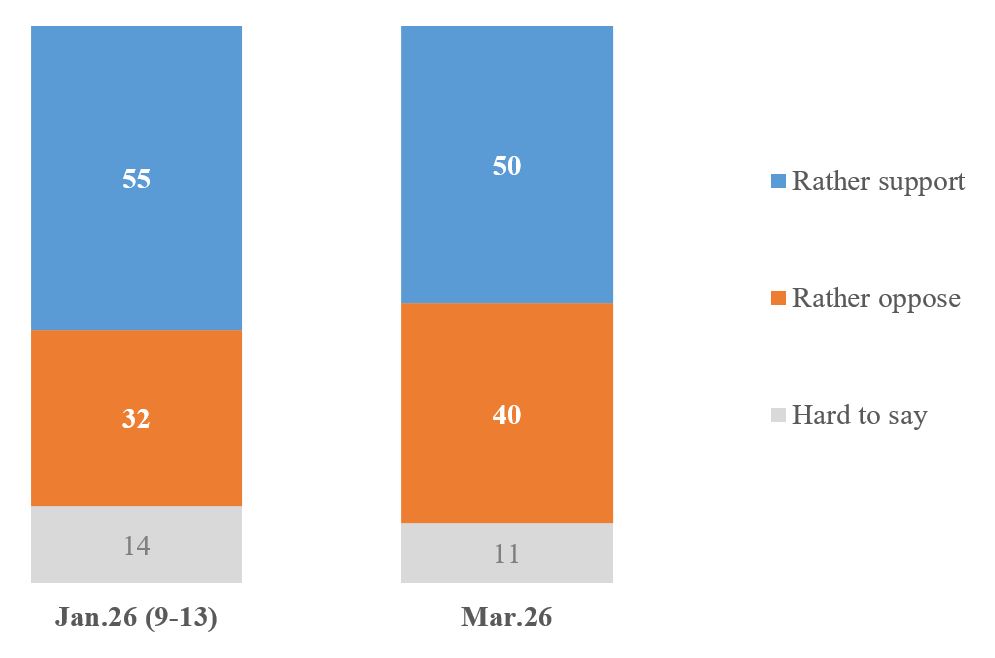
Graph 1 below shows how Ukrainians feel about the idea of a referendum. A relative majority of Ukrainians support the idea of holding a referendum, although there is a tendency for attitudes towards this idea to deteriorate. Thus, compared to mid-January 2026, the number of those who support such an initiative has decreased from 55% to 50%. On the other hand, the number of those who oppose it has increased from 32% to 40%.
Graph 1. Do you support or oppose holding a referendum on the peace deal?
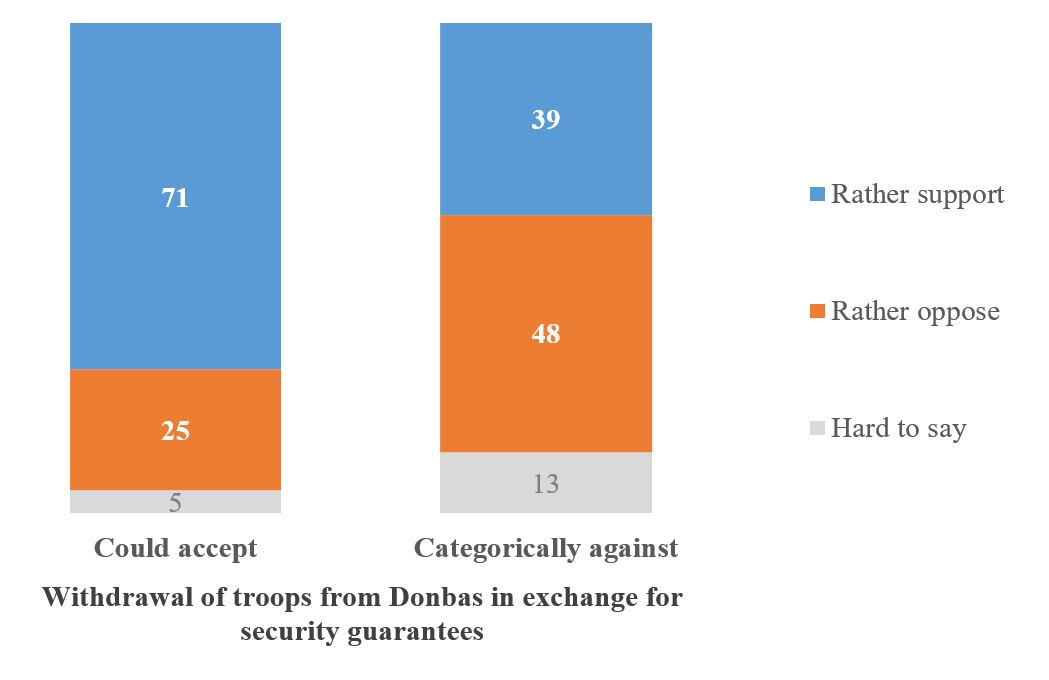
 Since January 2026, KIIS has been asking whether Ukrainians are ready to withdraw troops from Donbas in exchange for security guarantees from the US and Europe. The latest published results relate to the period up to mid-February 2026, and according to them, 57% of Ukrainians considered such a proposal categorically unacceptable. At the same time, 36% were ready to approve it (although mostly reluctantly)[2]. In the current survey (conducted now in early March), we also asked this question and will soon publish a separate press release. At the same time, Graph 2 below shows the data on how those who are ready to accept / categorically oppose the proposal to exchange Donbas for security guarantees feel about the idea of a referendum. As can be seen, the idea of a referendum is much more supported by those who are already ready to approve the withdrawal of Ukrainian troops from Donbas in exchange for security guarantees. Among them, 71% are positive about the idea of a referendum (against – 25%). Among those who are categorically against such a proposal regarding Donbas, 39% support the idea of a referendum, 48% are against, and 13% have an undecided attitude.
Graph 2. Attitude towards holding a referendum on the peace deal with disaggregation by support of the withdrawal of Ukrainian troops from Donbas in exchange for security guarantees
Personal willingness to participate in a referendum if it is held
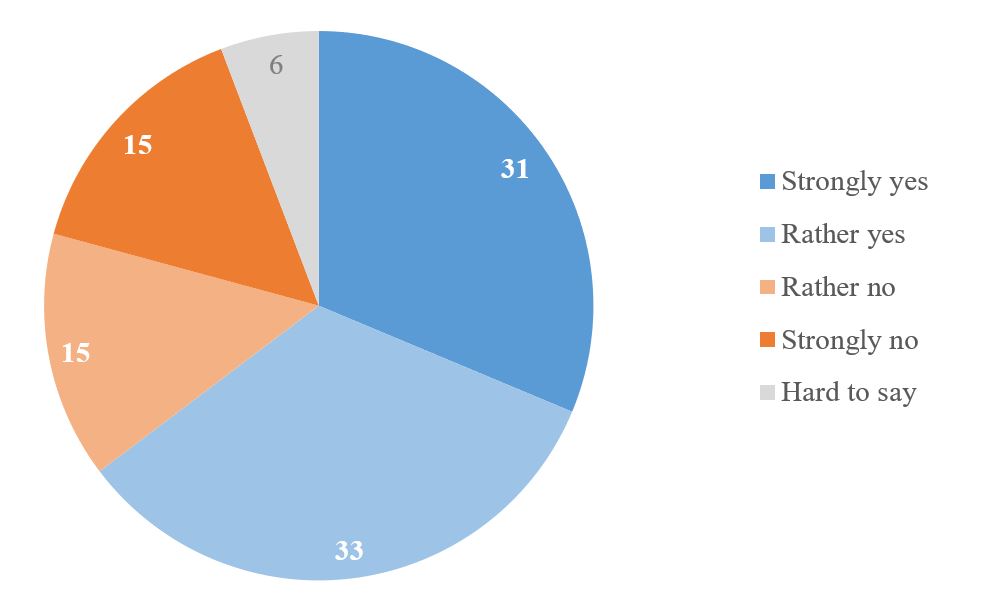
We also asked respondents whether they themselves would be willing to vote in such a referendum. 31% of respondents said they would definitely vote in a referendum if it were held. Another 33% said they would probably vote. That is, a total of 64% expressed their willingness to vote, although only half of them are definitely ready to do so. A third of respondents (30%) said they would probably or definitely not vote.
Graph 3. Will you personally vote or not in such a referendum?
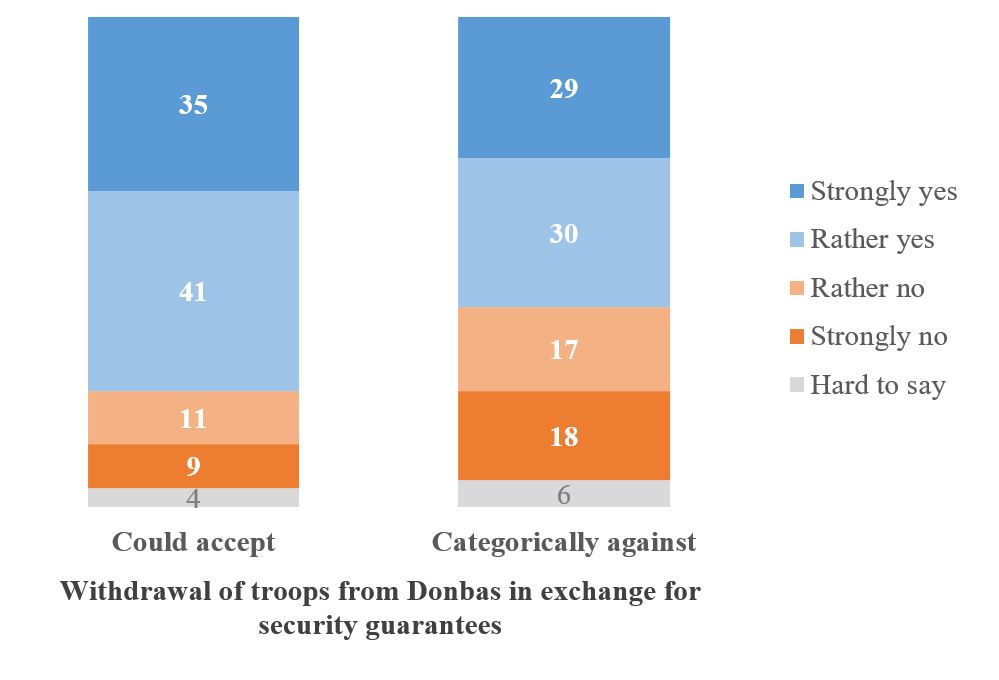
In addition, those respondents who are ready to support the withdrawal of Ukrainian troops from Donbas are somewhat more willing to vote in the referendum. Thus, among them 35% are definitely ready to vote, 41% are rather ready (total – 76%). Among those who are categorically against such an “agreement”, 29% will definitely vote and another 30% are rather ready to vote (total – 59%).
Graph 4. Willingness to vote in the referendumwith disaggregation by support of the withdrawal of Ukrainian troops from Donbas in exchange for security guarantees
The table below shows the willingness to vote by certain socio-demographic categories. Overall, the level of willingness to vote in such a referendum is quite similar across different socio-demographic categories.
Table 1. Willingness to vote in the referendumwith disaggregation by socio-demographic groups
Our data only represent the population of Government-controlled areas. Given that a significant part of the population is abroad and taking into account factors that reduce the willingness to vote (for example, security issues), there is a risk of low turnout and, as a result, lack of legitimacy. This problem was immediately discussed by Ukrainian experts and it also requires attention from Western partners. Ukrainian law requires a minimum turnout of 50% + 1 vote, but the question of who exactly should be counted in the turnout is open. For example, should Ukrainians in temporarily occupied territories be included in the denominator? Will any registration requirements be introduced for Ukrainians abroad (for example, can only those who have passed a certain registration be included in the denominator – just to artificially reduce the denominator and thus increase turnout)? And there are other questions. Moreover, even if the legal requirements of 50%+1 vote are met, in the event of a still low turnout (for example, 52%), there is a great risk that the public will not consider the vote legitimate. Recall that in 2019, the turnout in the first round of the presidential election was 62%, and in the parliamentary election - 49.8%. Given all the current problems, it is unlikely that we should expect a higher turnout (and rather, a much lower one).
Importance of formulating a question that can be put to a referendum
Before moving on to the results, we must emphasize once again that we are not modeling a real referendum scenario, since its parameters are unknown. The results that we analyze below are a way to show the importance of the formulation of a question that can be put to a referendum. In Ukraine, the last law on referendums was approved in 2021 (before that, in 2012). The founder of KIIS, Professor V. Paniotto, has repeatedly emphasized that the absence of articles that would regulate the formulation of questions can lead to significant distortions (see, for example, the article “Beware, referendum! When it matters who and how formulates the question”[4] from 2019 or the post “How to get the desired result in a referendum”[5] from 2013, but the considerations are quite relevant for the current law of 2021). The inspiration for the question below was the 2018 referendum in North Macedonia. In fact, citizens were supposed to support the renaming of the country, which was a difficult moment for identity. However, the question was formulated as follows: “Are you in favour of European Union and NATO membership by accepting the agreement between the Republic of Macedonia and the Republic of Greece?” That is, the question included positive points (membership in the EU and NATO) and avoided mention of difficult compromises. In Ukraine, a similar scenario is possible, when the referendum question is formulated to emphasize the benefits of a “peace deal” and “soften” difficult concessions (or not mention them at all). That is why we formulated the following experimental option: “Do you support the establishment of peace by approving a deal with the US and Europe, which includes Ukraine’s membership in the EU in 2027, territorial compromises, reliable security guarantees, and an economic reconstruction plan?” As you can see, we are talking about good things: peace, EU membership in 2027, reliable security guarantees and reconstruction (and all this without any details). And only involuntarily – about vague “territorial compromises”. That is, the above formulation seems to correspond to the description of a “peace deal”, but at the same time suffers from inaccuracies and can be considered manipulative. So, in this case, as you can see in the graph, 61% of respondents would vote “yes”, 10% – “no” (the rest – would not vote or were undecided). In terms of those who will come to vote, 86% would vote for, and 14% – against.
Graph 5. And if the following question were put to a referendum, would you vote yes, no, or abstain – would you not vote? “Do you support the establishment of peace by approving a deal with the US and Europe, which includes Ukraine’s membership in the EU in 2027, territorial compromises, reliable security guarantees, and an economic reconstruction plan?” 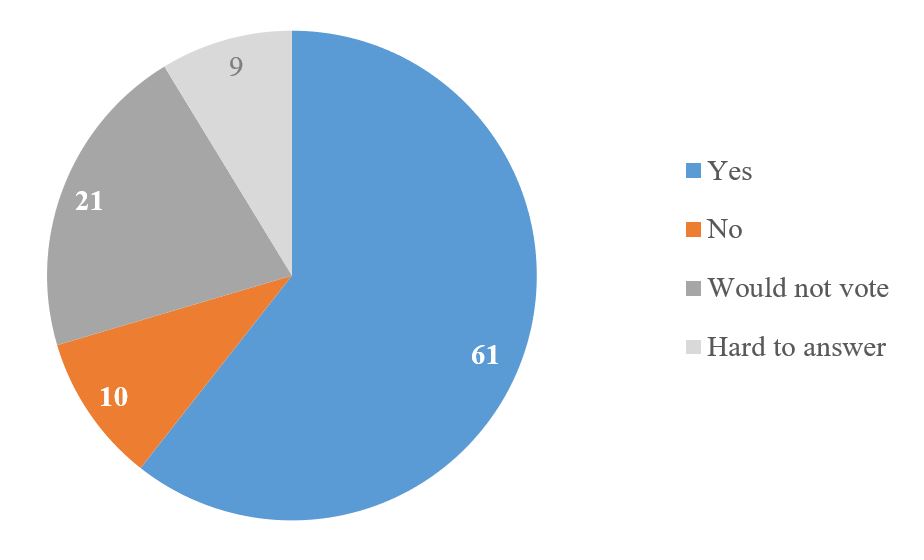
So, it is possible to get a positive result of the referendum with a “correctly” formulated question. That is, we see that the majority of Ukrainians reject the withdrawal of troops from Donbas in exchange for security guarantees (especially when the guarantees from the USA do not look convincing). But if all these points are “not mentioned” or “packaged” in nice words and accents, this increases the possibility of obtaining approval at the national referendum. It is clear that during the preparatory campaign and information, much will be clarified for citizens, but in the current situation there are high risks of manipulation of the referendum. This should be taken into account by the Ukrainian authorities, the Ukrainian public, and Ukraine’s Western partners.
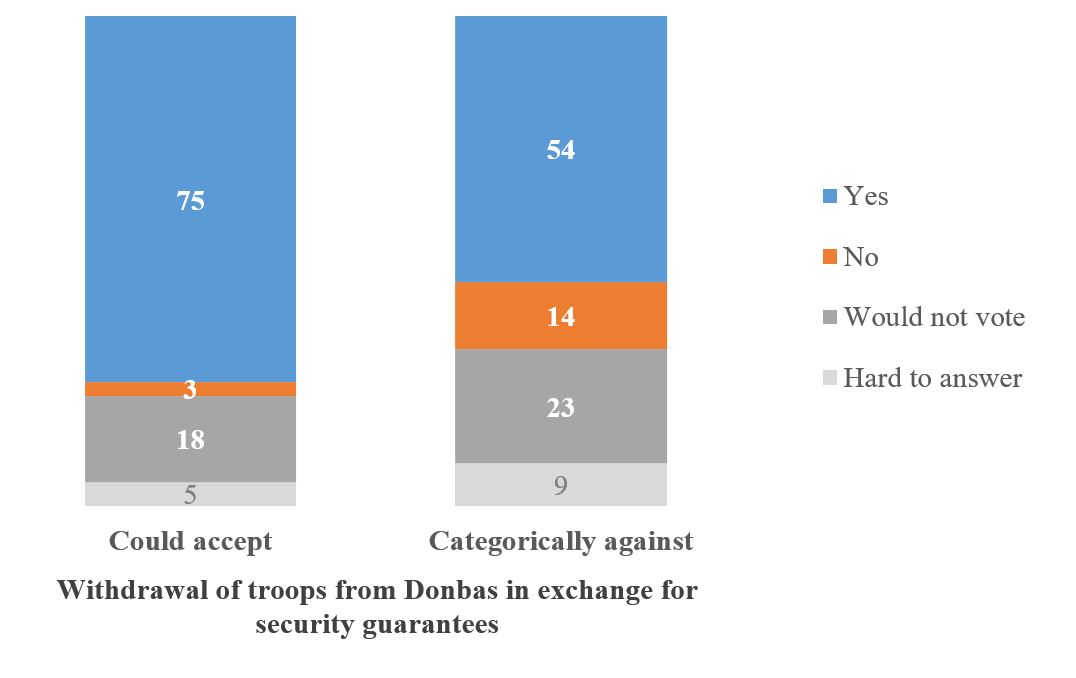
Additionally, the graph below shows that even among those who are categorically against exchanging Donbas for security guarantees, 54% are ready to vote “yes” in such a referendum (and only 14% would vote “no”).
Graph 6. Voting in a referendumwith disaggregation by support of the withdrawal of Ukrainian troops from Donbas in exchange for security guarantees
A. Grushetskyi, comments on the survey results:
The idea of a referendum continues to cause intense discussions, and not only among the expert community. At the same time, at the time of writing these lines, we (KIIS and the Ukrainian public in general) still do not know whether this idea is a real scenario that is being discussed and for which the political leadership is preparing, or, for example, this is just a diplomatic move by Ukraine. In the latter case, Ukraine demonstrates its openness to difficult compromises and readiness to approve them by the most legitimate means, but practically does not expect this to happen at all due to Russia’s irreconcilable position (and its consistent intention to destroy Ukraine). It is clear that in the conditions of an existential war and difficult negotiations, the country’s leadership cannot fully disclose the real situation, since this can cause significant harm to the cause of continuing resistance to Russian aggression. That is, the presence of the aforementioned uncertainty should be perceived as a necessity in the current conditions. At the same time, if there is at least a theoretical possibility of holding a referendum, it is also necessary to discuss the accompanying challenges. For example, specialized experts rightly discuss the technical possibility of organizing a referendum in a short time and the legal possibility (taking into account the requirements of the law) of calling it all a “referendum” (and not public consultations or something else that has a lower status than a referendum). As sociologists, we pay attention to the dimension of legitimacy from the point of view of Ukrainian public opinion. That is, the legislative framework can, for example, be quickly “adapted” by the Ukrainian parliament and other government bodies. However, even if such a vote complies with the “new” legislation, this does not mean that ordinary citizens will consider it legitimate (and even more so consider its result legitimate). And our survey indicates serious challenges and risks regarding such a referendum. So, firstly, the idea itself divides society and we do not have a consensus on the general expediency of holding it. Secondly, there are reasons to expect a low turnout, which may also vary among individual population groups. Thirdly, there are risks of manipulation at the level of question formulation, which will not reliably reflect the subject of the referendum. All this together may undermine the legitimacy of such a referendum and, if these problems are not resolved, may create a significant crisis in society after its holding.
Annex 1. Formulation of questions from questionnaire
Do you support or oppose holding a referendum on the peace deal? READ. ADD “OR” BETWEEN STATEMENTS. RANDOMIZATION OF ORDER
Will you personally vote or not in such a referendum?READ. RANDOMIZATION 1-4 OR 4-1
And if the following question were put to a referendum, would you vote yes, no, or abstain – would you not vote? “Do you support the establishment of peace by approving a deal with the US and Europe, which includes Ukraine’s membership in the EU in 2027, territorial compromises, reliable security guarantees, and an economic reconstruction plan?”
[1] War and peace: opinions and views of Ukrainians (results of a survey conducted on January 9-14, 2026) // https://kiis.com.ua/?lang=eng&cat=reports&id=1579&page=3 [2] Perception of negotiations and attitude to the offer to exchange Donbas for security guarantees: results of a survey conducted on February 12-24, 2026 // https://kiis.com.ua/?lang=eng&cat=reports&id=1589&page=1 [3] The composition of the macroregions is as follows: West – Volyn, Rivne, Lviv, Ivano-Frankivsk, Ternopil, Zakarpattia, Khmelnytskyi, Chernivtsi oblasts; Center – Vinnytsia, Zhytomyr, Kyiv, Kirovohrad, Poltava, Sumy, Cherkasy, Chernihiv oblasts, Kyiv city; South – Dnipropetrovsk, Zaporizhzhia, Mykolaiv, Odesa, Kherson oblasts; East – Donetsk and Kharkiv oblasts (formally, the macroregion also includes the Luhansk oblast, but due to the almost complete occupation, none of the respondents currently live there, although there are respondents who lived in this oblast until 2022). [4] Paniotto V. Beware, referendum! When it matters who and how formulates the question // https://www.pravda.com.ua/columns/2019/12/20/7235410/ [5] Paniotto V. How to get the desired result in the referendum // https://kiis.com.ua/?lang=ukr&cat=news&id=162
16.3.2026
|
Our social media:
 KIIS page
 KIIS channel