

ESC or click to close
|
Press releases and reports
Perception of negotiations, attitude to the offer to exchange Donetsk oblast for security guarantees, and how much longer are ready to endure war: results of a survey conducted on March 1-8, 2026
The press release was prepared by Anton Grushetskyi, executive director of KIIS
From March 1 to 8, 2026, the Kyiv International Institute of Sociology (KIIS) conducted its own all-Ukrainian public opinion survey "Omnibus", to which, on its own initiative, added questions about war and peace. By the method of telephone interviews (computer-assistedtelephoneinterviews, CATI) based on a random sample of mobile phone numbers (with random generation of phone numbers and subsequent statistical weighting) in all regions of Ukraine (the territory controlled by the Government of Ukraine), 1,003 respondents were surveyed. The survey was conducted with adult (aged 18 and older) citizens of Ukraine who, at the time of the survey, lived in the territory of Ukraine controlled by the Government of Ukraine. The sample did not include residents of territories temporarily not controlled by the Ukrainian authorities (at the same time, some of the respondents are IDPs who moved from the occupied territories), and the survey was not conducted with citizens who left abroad after February 24, 2022. Formally, under normal circumstances, the statistical error of such a sample (with a probability of 0.95 and taking into account the design effect of 1.3) did not exceed 4.1% for indicators close to 50%, 3.5% for indicators close to 25%, 2.5% for indicators close to 10%, 1.8% for indicators close to 5%. Under conditions of war, in addition to the specified formal error, a certain systematic deviation is added. Factors that may affect the quality of results in "wartime" conditions were previously cited by KIIS. In general, we believe that the obtained results are still highly representative and allow a fairly reliable analysis of the public moods of the population.
Do Ukrainians believe that the current negotiations will lead to a lasting peace
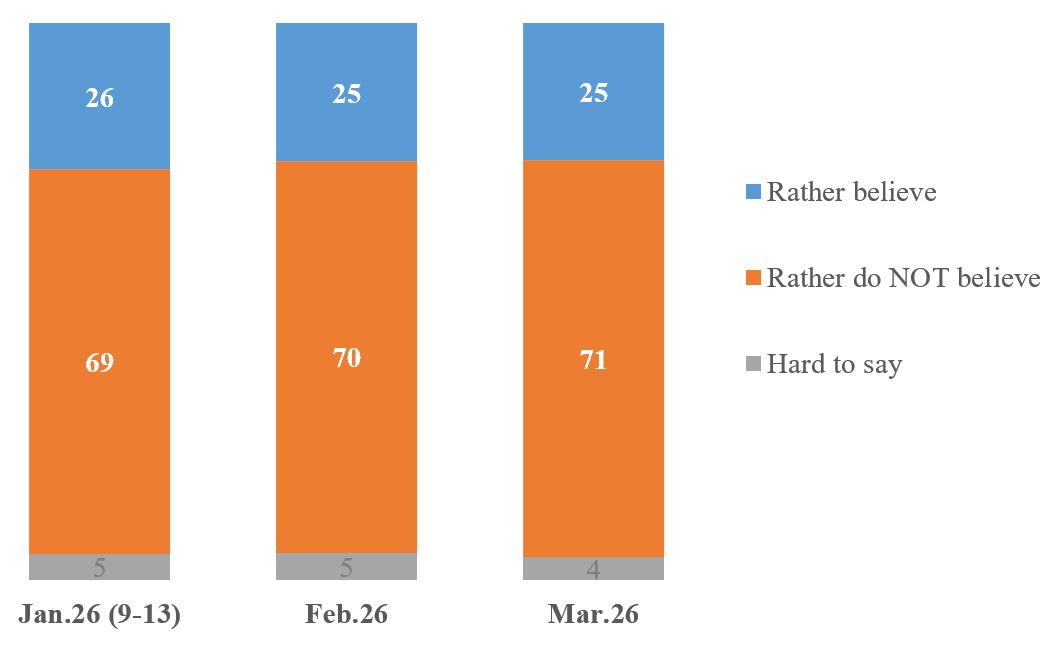
The vast majority of Ukrainians – 71% – do not believe that the current negotiations will lead to lasting peace in Ukraine. Believe – 25%. As can be seen, there have been no changes on this issue since the beginning of 2026. Skepticism about the success of the current peacekeeping efforts is quite crystallized and persistent among the Ukrainian public.
Graph 1. Do you believe or not that the current negotiations will lead to lasting peace in Ukraine?
In this case, it is advisable to recall the following information:
Attitude towards the transfer of the entire Donetsk oblast under Russian control in exchange for security guarantees from the USA and Europe
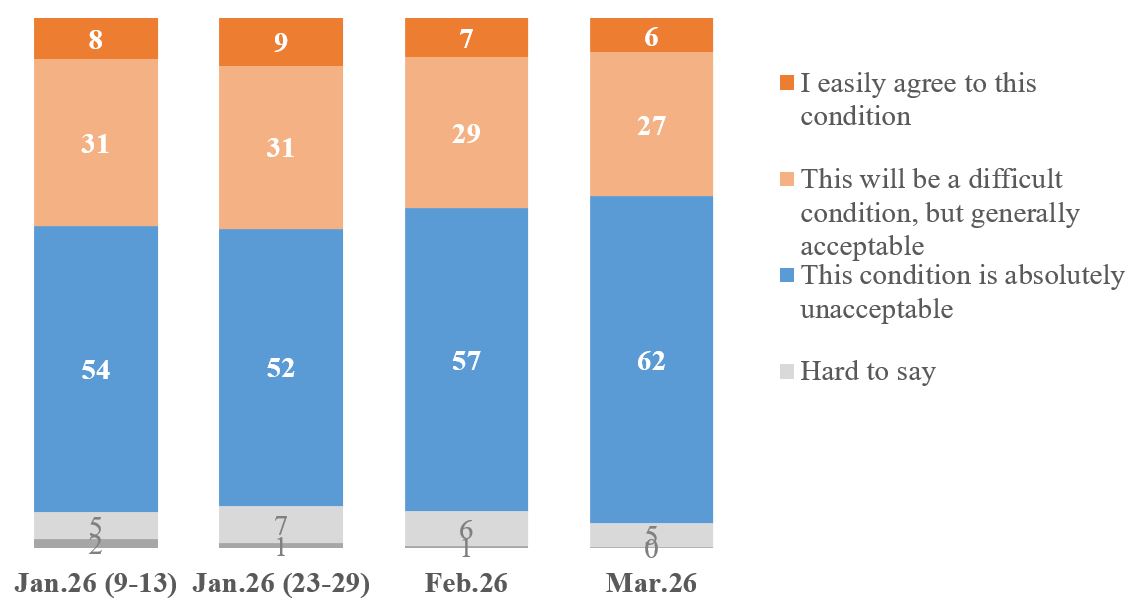
Since January 2026, KIIS has been asking the question whether Ukrainians are ready to withdraw troops from the Donetsk oblast in exchange for security guarantees from the USA and Europe. Thus, 62% of respondents consider it categorically unacceptable to transfer the entire Donbas under Russian control in exchange for security guarantees. At the same time, 33% are ready for such a concession (although most of them admit that this is a difficult condition). Another 5% could not decide on their opinion. Compared to mid-February 2026, there has been a slight increase in those who are categorically against, from 57% to 62%. The share of those who agreed in February was 36%, now it is 33%. In general, it can be seen that over the past few months, public opinion on this issue has not changed significantly and the majority of Ukrainians are critical of such an initiative. At the same time, let us recall that our experiment in mid-February showed that if to specify the security guarantees from the US and directly state that they will not include the deployment of their troops in Ukraine, the closure of the skies, and the free provision of weapons, then support for the proposal is significantly lower[3].
Graph 2. Now I will read out a possible condition for achieving peace, and you tell me how acceptable it is to you. Use the scale “I easily agree with this condition”, “This will be a difficult condition, but generally acceptable”, “This condition is absolutely unacceptable”. Ukraine withdraws its troops from the territories of Donbas that it currently controls, i.e. from Kramatorsk, Sloviansk, etc., and these territories pass under Russian control. In return, the USAand Europe give Ukraine security guarantees
Further in the press release we consider how much longer Ukrainians are ready to endure the war. At the same time, in the context of the proposal to exchange the Donetsk oblast for security guarantees, we should immediately note that among those who are ready to endure a short period (several months to six months), 54% are ready to approve such a “proposal” (although mostly reluctantly). Categorically against – 40%. Among those who are ready to endure 1 year, 47% are ready to approve and 48% are categorically against. And among those who are ready to endure the war for as long as necessary, 21% are ready to approve and 77% are categorically against. How many Ukrainians are still ready to endure war
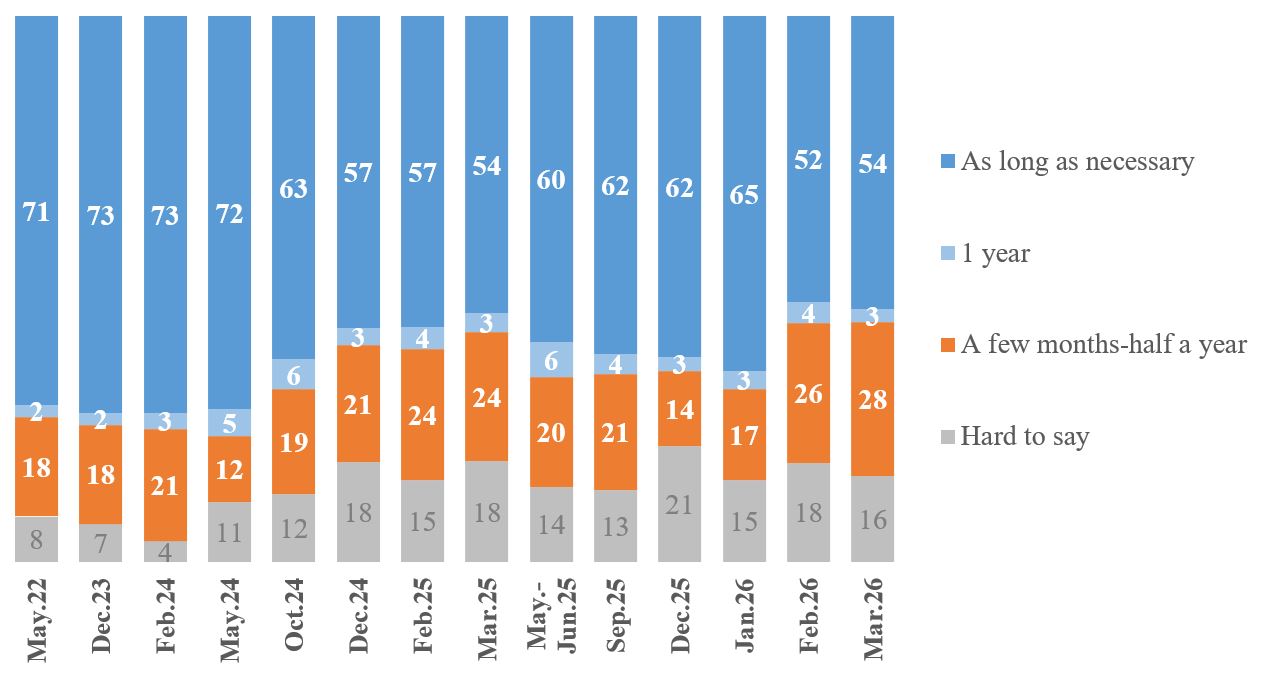
Between the end of January and mid-February 2026, there was a significant decrease in the share of those who are ready to endure war as long as necessary. If at the end of January there were 65%, then in mid-February it was already 52%. In March 2026, we re-asked this question to see if the trends would continue. As can be seen, a March survey confirms the negative dynamics identified, but without further deterioration (at least for now). Thus, 54% of Ukrainians are ready to endure war as long as necessary. At the same time, 28% of citizens say about a shorter period (several months - half a year).
Graph 3. How much longer are you ready to endure war?
We decided to analyze among which categories of the population there was a decrease in the share of those who are ready to endure as long as necessary. As we found, the most differentiated decrease occurred depending on the attitude towards the proposal to exchange the Donetsk oblast for security guarantees. As can be seen in Table 1, among those who easily agree with such a “proposal”, the indicator decreased from 38% to 26%, and among those who reluctantly agree – from 58% to 35%. In addition, among those who have an uncertain attitude, a decrease is also observed from 52% to 25%. On the other hand, among those who are categorically against, the change in the indicator, although there is also one, is much smaller - it was 74%, now it is 67%. That is, the main segment of the decrease in readiness to endure war is those who were prepared for a difficult exchange of control over the Donetsk oblast in exchange for security guarantees. Perhaps these people had increased expectations from the outcome of the negotiations at the end of January (and, in particular, taking into account the fact that K. Budanov is part of the Ukrainian delegation). However, when it became more obvious in February that the negotiations were not leading to real progress, this had a demoralizing effect on this segment of the population. At the same time, for those who previously rejected such a demand and did not expect rapid progress, little has changed and therefore this has less of an impact on their readiness to endure war. While this explanation now seems plausible, other factors could also have had an impact. For example, February is traditionally a more depressing season (although the current survey was conducted in early March). Also, people may have been more internally mobilized at the end of January amid challenges from the energy situation. And when the situation improved somewhat in February, some people felt more emotional. And also, it is possible that some people expected Western partners (especially the USA) to support Ukraine more strongly after the Russian terror in the harsh winter. The lack of a significant response in the eyes of many people could also have had a demoralizing effect. In addition, the USA and Israeli operation against Iran in early March could have had an impact. Some people may see the geopolitical situation getting more complicated and expect less support for Ukraine (or, for example, easing sanctions on Russia or its profit from the war).
Table 1. Share of those ready to endure as long as necessary, depending on readiness to exchange Donbas for security guarantees
A. Grushetskyi, comments on the survey results:
Ukrainians continue to be pessimistic about the prospects of the current peace negotiations and do not have excessive expectations. The main reason is the distrust of Russia (which constantly openly demonstrates its goal to destroy Ukraine), but also a significant problem is the crisis of confidence in Western partners, especially the USA. For Ukrainians, security guarantees are a fundamental point, and for the majority, peace will have no meaning or value if this peace is “on any terms.” Therefore, Ukrainians expect reliable security guarantees (filled with concrete content, not empty “assurances” under the Budapest Memorandum, which are currently not recognized on both sides of the ocean). In January 2026, we asked whether Ukrainians believe that the USA, within the framework of the promised security guarantees, will provide all the necessary support to repel a possible second attack by Russia. And only 40% answered in the affirmative[4]. And given the intense USA involvement in the operation against Iran, it is likely that even more Ukrainians will now doubt that the USA will be able to provide the means to repel Russian aggression. At the same time, a worrying trend is the decrease in the share of those who are ready to endure war as long as necessary. Perhaps this is a temporary decrease and the adaptation period is currently underway. A similar situation was in the first half of 2025, when both the readiness to endure war and optimism about the country's future decreased, but then, in the second half of 2026, the indicators returned to higher levels. However, this may also be a longer-term trend, given that the full-scale war has been going on for more than 4 years, and the geopolitical situation around Ukraine and in the world as a whole has become significantly more complicated. In any case, the moral and psychological state of the population requires attention, and KIIS continues to monitor moods.
Appendix 1. Formulation of questions from the questionnaire
How much longer are you ready to endure war? READ
Do you believe or not that the current negotiations will lead to lasting peace in Ukraine? READ. ADD "OR" BETWEEN STATEMENTS. ORDER RANDOMIZATION
Now I will read out a possible condition for achieving peace, and you tell me how acceptable it is to you. Use the scale “I easily agree with this condition”, “This will be a difficult condition, but generally acceptable”, “This condition is absolutely unacceptable”. Ukraine withdraws its troops from the territories of Donbas that it currently controls, i.e. from Kramatorsk, Sloviansk, etc., and these territories pass under Russian control. In return, the USA and Europe give Ukraine security guarantees
[1] War and peace: thoughts and views of Ukrainians (results of a survey conducted on January 9-14, 2026) // https://kiis.com.ua/?lang=ukr&cat=reports&id=1579&page=3 [2] Perception of the proposal of Ukraine and the USA for a 30-day temporary ceasefire // https://www.kiis.com.ua/?lang=ukr&cat=reports&id=1509&page=1 [3] Perception of negotiations and attitude to the offer to exchange Donbas for security guarantees: results of a survey conducted on February 12-24, 2026 // https://www.kiis.com.ua/?lang=ukr&cat=reports&id=1589&page=1 [4] War and peace: thoughts and views of Ukrainians (results of a survey conducted on January 9-14, 2026) // https://kiis.com.ua/?lang=ukr&cat=reports&id=1579&page=3 [5] The composition of the macroregions is as follows: West – Volyn, Rivne, Lviv, Ivano-Frankivsk, Ternopil, Zakarpattia, Khmelnytskyi, Chernivtsi oblasts; Kyiv city – only Kyiv city (without the oblast); Center / North – Vinnytsia, Zhytomyr, Kyiv, Kirovohrad, Poltava, Sumy, Cherkasy, Chernihiv oblasts; South – Mykolaiv, Odesa, Kherson oblasts; Lower Dnieper region – Dnipropetrovsk, Zaporizhzhia oblasts; East – Donetsk and Kharkiv oblasts (formally, the macroregion also includes the Luhansk oblast, but due to the almost complete occupation, none of the respondents currently live there, although there are respondents who lived in this oblast until 2022).
20.3.2026
|
Our social media:
 KIIS page
 KIIS channel