

ESC or click to close
|
Press releases and reports
Attitude towards the ceasefire along the current front line: results of a survey conducted during May 7-June 3, 2026
The press release was prepared by Anton Grushetskyi,executive director of KIIS
From May 7 to June 3, 2026, the Kyiv International Institute of Sociology (KIIS) conducted its own all-Ukrainian public opinion survey, to which, on its own initiative, added a question about a ceasefire along the current front line. Bythemethodoftelephoneinterviews (computer-assistedtelephoneinterviews, CATI) based on a random sample of mobile phone numbers (with random generation of phone numbers and subsequent statistical weighting) in all regions of Ukraine (the territory controlled by the Government of Ukraine), 2007 respondents were surveyed. The survey was conducted with adult (aged 18 and older) citizens of Ukraine who, at the time of the survey, lived in the territory of Ukraine controlled by the Government of Ukraine. The sample did not include residents of territories temporarily not controlled by the Ukrainian authorities (at the same time, some of the respondents are IDPs who moved from the occupied territories), and the survey was not conducted with citizens who left abroad after February 24, 2022. Formally, under normal circumstances, the statistical error of a sample of 2,000 respondents (with a probability of 0.95 and taking into account the design effect of 1.3) does not exceed 2.8%. At the same time, an experiment was conducted as part of a survey on the issue of a ceasefire along the current front line: respondents were randomly divided into 4 subsamples and a separate ceasefire scenario was read to each. About 500 respondents responded to each of the 4 scenarios. The error for such a sample is 5.8%. Under conditions of war, in addition to the specified formal error, a certain systematic deviation is added. Factors that may affect the quality of results in "wartime" conditions were previously cited by KIIS. In general, we believe that the obtained results are still highly representative and allow a fairly reliable analysis of the public moods of the population.
Since May 2022, KIIS has been constantly monitoring the public moods of Ukrainians regarding their readiness to support the end of the war in exchange for territorial concessions. At the same time, as the context and framework of discussions change (especially against the backdrop of “peace talks”), we adapt and test new wording of questions that would better reflect current realities. Thus, our experiments have shown that the wording “territorial concessions” is not unambiguous and the attitude towards them depends on what exactly we mean: “freezing” the current front line, officially recognizing the occupied territories as part of Russia, or transferring territories controlled by Ukraine under Russian control[1]. While in the first case (“freezing”) one could see room for discussion, in the other two cases the majority rejects such demands. At the same time, this shows that the use of the ambiguous concept of “territorial concessions” can become part of information manipulation (if there is no proper explanation and interpretation). After the start of public discussions on the proposal to withdraw Ukrainian troops from the Donetsk region in exchange for security guarantees from the USA and Europe, we began asking the corresponding question in January. Moreover, we are mostly observing a stable situation of categorical rejection of the exchange of Donetsk region for security guarantees by the majority of Ukrainians (the last time in April 2026, 57% were categorically against it). Now, in May 2026, we have decided to explore in more depth the attitude towards a ceasefire along the front line. This issue remains an important component of the Ukrainian peace proposal, as confirmed, in particular, by the recent open letter of President V. Zelenskyy to the Russian ruler V. Putin.
Attitude towards the ceasefire along the current front line
For Ukrainians, one of the most important factors (perhaps even the most important) in any peace agreement is the format of security guarantees that will make it impossible for Russia to invade again and start a new war. Therefore, we prepared 4 ceasefire scenarios, and only 1 randomly selected scenario was read to the respondent. Each scenario assumed a ceasefire exactly on the current front line and that Russia actually retains control over the occupied territories, however, without official recognition (since, as we have seen in our surveys, this is a significant “red line”). At the same time, the security component differed:
So, if Ukraine does not receive security guarantees and there is no significant supply of money and weapons, then 61% will categorically reject such a proposal for a truce on the current front line. Will be ready to approve it – 32% (mostly reluctant).
Graph 1. Please imagine that a ceasefire is being discussed along the current front line. Russia retains control over all occupied territories without international recognition. At the same time … Split-sample experiment – the respondent was asked one randomly selected question 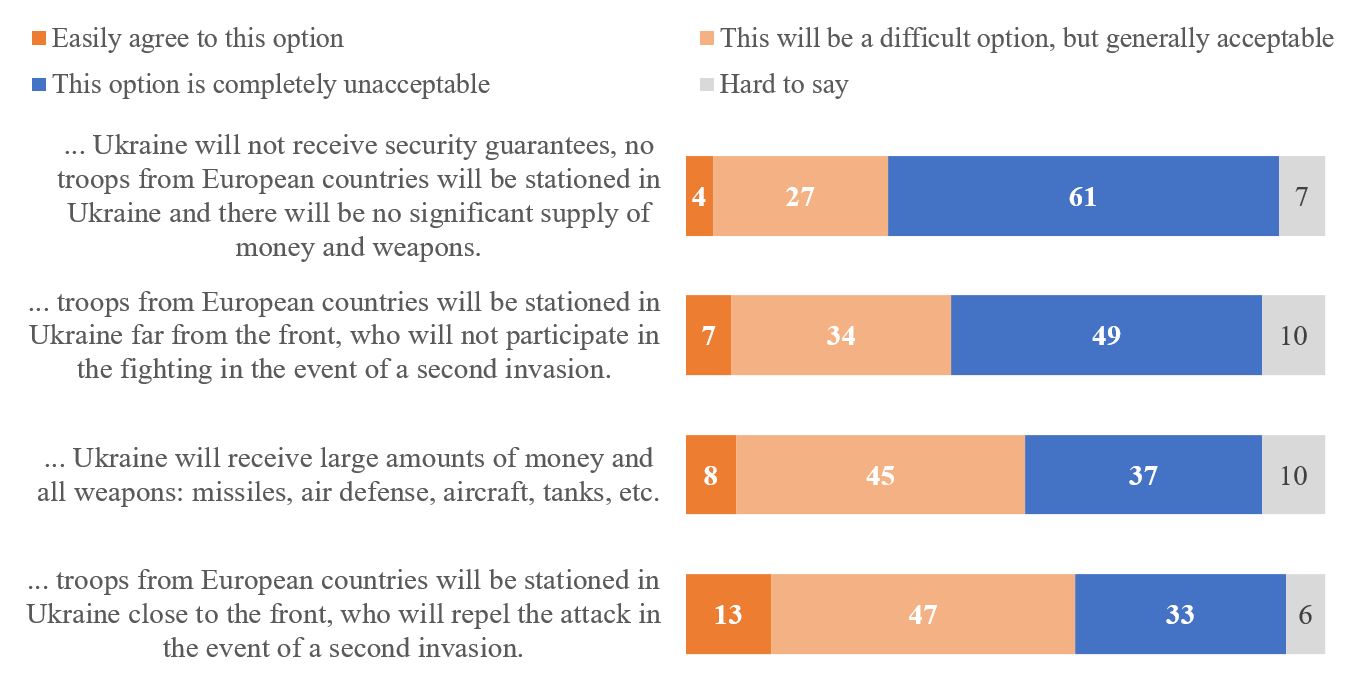
If troops from European countries are stationed in Ukraine far from the front line, who will not take part in the fighting in the event of a second invasion, then 42% will be ready to approve a ceasefire along the front line. 49% categorically reject such a proposal. That is, this option is perceived better than a simple ceasefire, but there are still more opponents. In the case of a scenario where security guarantees are provided in the form of large amounts of money and weapons, 53% would be ready to approve a ceasefire along the current front line. Categorically reject such a scenario – 37%. In this case, there are significantly more people who are ready to approve such an option (than those who categorically reject it). The most supported option is one in which European troops are stationed close to the front line in Ukraine to repel an attack in the event of a second invasion. In this case, 61% would be ready to approve a ceasefire along the front line. Categorically reject – 33%.
Attitude towards the ceasefire along the current front line in terms of region of residence
The table below shows the results in terms of region. As can be seen, the difference between the regions of Ukraine is quite small (and in almost all cases within the margin of error). In any case, the same trend persists - in each region, the majority is against a ceasefire without security guarantees (in particular, in the East - 57%, in the South - 56%). At the same time, in all regions (except the West, where parity is observed), the majority is ready for the option of increased support for Ukraine with money and weapons. And in all regions, the majority also agrees with the option with European forces near the front line, ready to repel a Russian attack (and the option with a symbolic presence of European troops has an ambiguous perception).
Table 1. Attitude towards the ceasefire along the current front line in terms of region of residence
A. Grushetskyi, comments on the survey results:
Our survey once again shows that Ukrainians are open to constructive dialogue to end the war and are even ready to make difficult territorial concessions. The only party that is disrupting the peace process and that bears full responsibility for the continued destruction and death (including on its own territory) is Russia. At the same time, firstly, Ukrainians are not simpletons who are ready to agree to anything for “sweet promises”. The bitter experience of giving up nuclear weapons in exchange for empty promises of the Budapest Memorandum has proven that even the most powerful countries in the world, as it turned out, violate their obligations. The Minsk agreements have taught us that a simple ceasefire without reliable security guarantees will only be a temporary truce until the next Russian offensive, since Russia’s goal has not changed – the destruction of Ukraine and the Ukrainian nation (as the Russian dictator once again reminded us at the St. Petersburg International Economic Forum when he spoke about the “denazification” of Ukraine). Therefore, Ukrainians are absolutely right to point out that a ceasefire should take place together with security guarantees. At the same time, we see pragmatism in the reasoning of Ukrainians. So, European troops near the front are the most reliable option. However, given that it is unrealistic, the majority are ready to accept the option when Ukraine receives increased funding and weapons. Ukrainians are ready to fight and die for their country themselves - only then provide funding and weapons. Secondly, we see a certain confidence of Ukrainians in themselves and their forces, we see the resilience and will to continue the resistance further, which is why it is expected that the result of the agreements should be a compromise. And not the fulfillment of all Russian demands, only in a more acceptable (especially for some Western enthusiasts) wrapper. That is, if Ukrainians agree to difficult concessions (de facto control of Russia over Ukrainian territories without official recognition is already a huge, very difficult concession, which for some reason is not always understood by Western partners), then Russia must roll back its demands. However, this just demonstrates that Russia is still unable to see Ukraine as a subject. Ukrainians want peace, Ukrainians are open to negotiations and painful compromises. However, Ukrainians categorically reject capitulation and peace “on any terms.” Pressure should be put not on Ukraine, but on Russia. The struggle continues and Ukrainians are determined to succeed.
Appendix 1. Formulation of questions from the questionnaire
Please imagine that a ceasefire is being discussed along the current front line. Russia retains control over all occupied territories without international recognition. RANDOMLY ONE OF THE OPTIONS: А – At the same time, Ukraine receives large amounts of money and all kinds of weapons: missiles, air defense systems, planes, tanks, etc. В – At the same time, troops from European countries are stationed in Ukraine far from the front, and in the event of a second invasion, they will not participate in the fighting.. С – At the same time, troops from European countries will be deployed close to the front in Ukraine, which will repel the attack in the event of a repeated invasion. D – At the same time, Ukraine will not receive security guarantees, no troops from European countries will be stationed in Ukraine, and there will be no significant supply of money and weapons. You… READ
[1] Opinions and views of Ukrainians on issues of war and peace: December 2025 // https://kiis.com.ua/?lang=ukr&cat=reports&id=1572&page=7 [2] The composition of the macroregions is as follows: West – Volyn, Rivne, Lviv, Ivano-Frankivsk, Ternopil, Zakarpattia, Khmelnytskyi, Chernivtsi oblasts; Center – Vinnytsia, Zhytomyr, Kyiv, Kirovohrad, Poltava, Sumy, Cherkasy, Chernihiv oblasts, Kyiv city; South – Dnipropetrovsk, Zaporizhzhia oblasts, Mykolaiv, Odesa, Kherson oblasts; East – Donetsk and Kharkiv oblasts (formally, the macroregion also includes Luhansk oblast, but due to almost complete occupation, none of the respondents currently live there, although there are respondents who lived in this oblast until 2022).
8.6.2026
|
Our social media:
 KIIS page
 KIIS channel